
Data Cable Installation, in the Order It Happens
A structured cabling install is a sequence, and most of the problems that show up in year three were created by skipping a step in year one. Here is how KSEDCO runs the work on Georgia projects, in the order the steps occur.
Before anything is pulled
Drop counts get reconciled against the furniture plan and the wireless design, not just the architectural drawing, because access points and cameras usually add more drops than the desks do. Telecom room locations get checked against real measured pathway distances so no permanent link exceeds 90 meters. Category is chosen last, and it is chosen for the powered devices: Category 6A is normally the right answer where cable will carry higher-wattage PoE to access points and cameras, because heat rise inside a bundle is a function of conductor size and how many energized pairs sit together.
Rough-in and the pull
Containment goes up first: tray, J-hooks, sleeves and firestop, sized with room to add later rather than filled on day one. Cable is pulled by hand or with tension-limited equipment, supported at the intervals the standard calls for, and never laid on ceiling grid wire, sprinkler pipe or duct. Bend radius is respected at the panel, which is where it is most often violated because that is where cable is under the most pressure to turn.
Termination and dressing
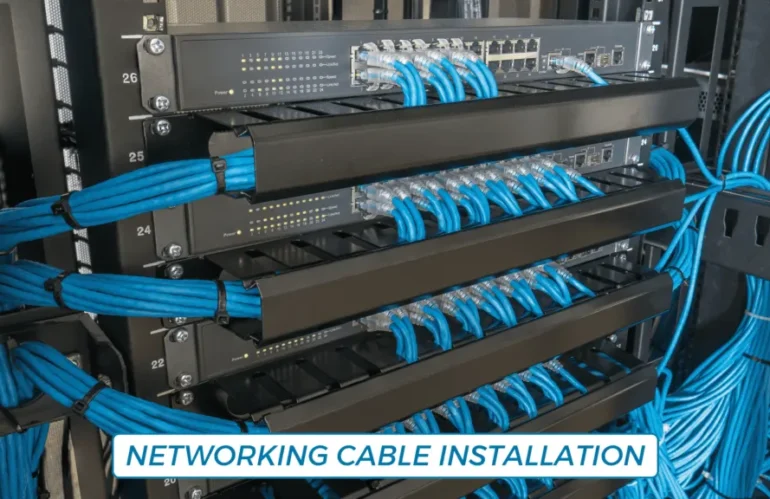
Pair twist is maintained right up to the punch, jackets are stripped to the minimum, and the bundle is dressed so a technician can trace a run three years from now without pulling the rack apart. Racks get bonded to the telecom room busbar, and the busbar gets bonded back to the building’s telecom main. This is unglamorous and it is the single best predictor of whether the plant behaves.
Testing and certification
Every link is tested to the applicable TIA performance standard with a calibrated field tester, and the results are saved per link, not summarized as a pass rate. Fiber gets both an insertion loss test and, on longer runs, a trace so that a splice or a tight bend has a location rather than a suspicion. Failures are re-terminated and re-tested, and the re-test is the record that ships.
Labeling and as-builts
Labels follow a documented scheme at both ends and on the panel, printed rather than handwritten. You receive the test files, the labeling scheme, a rack elevation and marked-up plans showing the routes as installed. If a set of drawings does not match what is in the ceiling, the drawings are wrong, so we correct them before closeout.
What Georgia conditions change
- Heat. Cable in the roof deck of an unconditioned distribution building along I-16 or I-75 runs far hotter in summer than the temperature at floor level suggests. Copper attenuation rises with temperature, so bundle sizes stay smaller and lengths get planned with margin rather than to the limit.
- Lightning and building-to-building runs. Georgia sees a high number of thunderstorm days. Any run between separate structures is planned as fiber, which carries no ground potential difference between two grounding systems and removes the surge path entirely.
- Moisture underground. Georgia clay holds water. Outside plant runs use water-blocked or gel-filled cable in innerduct rather than direct-buried riser cable, and handholes get planned as if they will be full, because they will be.
- Coastal exposure. Outdoor enclosures near Savannah and the coastal plain are specified for salt air and driven rain, not just for rated ingress protection on a shelf.
For a scope review or a fixed-price cabling proposal, call (888) 360-0035 or contact the Georgia office at 2700 Cumberland Pkwy SE, Suite 410, Atlanta GA 30339.