
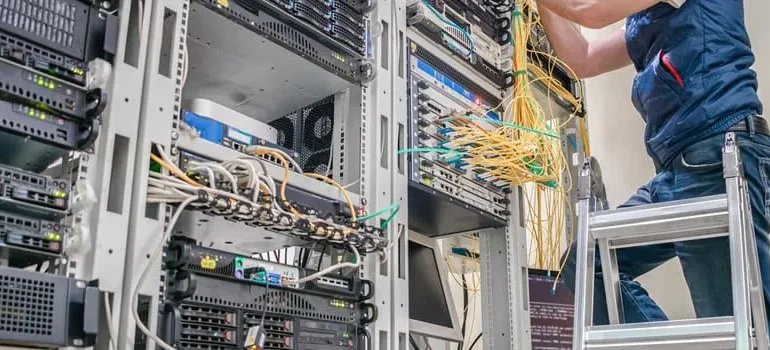
Decommissioning: The Drive Is the Liability, Not the Chassis
A five-year-old switch has almost no resale value. A single uncontrolled hard drive leaving a building has a great deal of downside value. That asymmetry should shape every decision in a decommission, which is why a removal plan starts with storage media and treats everything else as logistics.
Clear, Purge or Destroy, and Record Which
NIST Special Publication 800-88 gives this work its vocabulary, and the terms are worth using precisely. Clear is a logical overwrite that defeats ordinary recovery. Purge is stronger sanitization, including cryptographic erase on self-encrypting drives. Destroy is physical: shredding, disintegration or degaussing of magnetic media. Which level applies depends on what was stored and where the device goes next.
The working rule is simple. A drive that will not accept or verify a sanitization command gets destroyed, not shelved. That decision is made on the floor, recorded against the serial number, and reflected in the certificate you receive at the end. A certificate that counts drives instead of listing serials is not evidence of anything.
Order of Operations in the Room
- Photograph the rack and label ports before anything is unplugged, because those photos answer questions for months afterward
- Pull running configurations off switches, routers and firewalls before power-down, since once the device is gone so is the only copy
- Capture serials and asset tags at the rack, not at the truck
- Trace and remove patch cabling, and remove accessible abandoned cable, which building codes require and lease turnover language usually does too
- De-rack from the top down, heaviest units last, with rails coming out after the equipment rather than with it
- Handle UPS batteries separately, since sealed lead-acid units are regulated for transport and disposal and do not belong on a general electronics pallet
Chain of Custody
Serials captured at the rack, containers sealed and numbered, a signature at every transfer, and a serialized certificate at the end. If equipment sits overnight, someone owns it overnight and that is written down. This is the part most quotes leave vague, and it is exactly the part that matters if you are ever asked to prove what became of one specific asset.
Where This Comes Up in Georgia
- Suite handbacks in metro Atlanta. Office footprints in the Cumberland and Perimeter submarkets have been reshuffling for years. Leases commonly require space returned closer to shell, which puts cable removal, rack removal and firestop patching on the tenant’s exit checklist and on the tenant’s clock.
- Clinical refreshes. Health systems and clinics in metro Atlanta and Augusta carry protected health information on imaging workstations, multifunction copiers and handhelds that nobody thinks of as storage devices. The copier hard drive is a recurring surprise.
- Plant and warehouse upgrades near Macon and Columbus. Ruggedized handhelds, industrial PCs and wireless controllers hold stored network credentials long after they have stopped being useful for anything else.
- Defense-adjacent employers around Augusta. Organizations working near the Fort Gordon cyber and defense cluster often operate under media handling rules that prohibit storage devices leaving the site at all. Establish that constraint before scheduling, because it changes the entire method.
Questions Worth Asking Any Removal Vendor
- Which downstream recycler receives the material, and does it hold R2 or e-Stewards certification?
- Will the certificate list serial numbers, and will it state the sanitization method used for each device?
- Who has custody between the loading dock and the recycler, and for how long?
- What happens to a drive that fails sanitization, and who signs off on that call?
KSEDCO handles decommissioning, secure removal and relocation for Georgia sites from our Atlanta office at 2700 Cumberland Pkwy SE, Suite 410. Call (888) 360-0035 to plan a removal.