
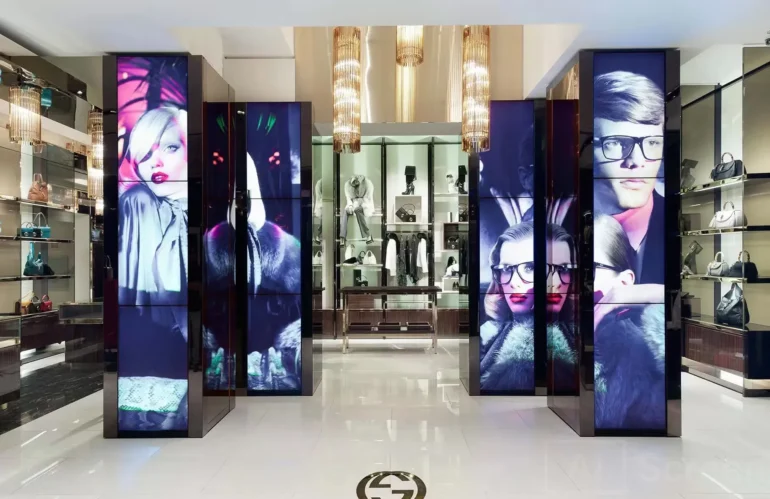
Digital Signage That Holds Up in a Georgia Storefront
Most digital signage complaints trace back to a decision made before anyone picked up a drill: the wrong display went on the wall. KSEDCO installs commercial signage across Georgia — Atlanta office lobbies and tenant fit-outs, retail and quick-service locations, distribution facilities along I-16 and I-75, clinic and hospital waiting areas — and the survey we run is mostly about matching the panel to the light, the duty cycle, and the environment it will actually live in.
Brightness and duty cycle come first
A consumer television is built for a few hours a day in a dim room, typically in the 250 to 350 nit range. A lobby on Cumberland Parkway with a west-facing glass curtain wall will wash that out completely by four in the afternoon. Window-facing and high-ambient placements need high-brightness commercial panels, and sun-exposed storefront glass usually needs several times that output before the content reads from the sidewalk. We also match the panel’s rated duty cycle to the schedule. A display rated for 16 hours a day, seven days a week, put into a 24/7 dock-status application, will fail early — and the warranty terms will say so.
Orientation, mounting, and the wall behind it
Portrait mounting is not just rotating the display. Many panels are only rated for portrait operation if the vent path allows it, and trapped heat behind a rotated chassis is a common cause of early failure. Before mounting we confirm what is behind the finish — metal stud, CMU, or a tenant demising wall we may not be allowed to penetrate — and add backing where the mount and panel weight require it. Menu board arrays and video walls get a single leveling structure rather than individual mounts, because a quarter inch of drift between panels is visible from across the room.
Power, player, and the content path
Signage fails quietly when the content path is an afterthought. We plan where the media player lives — behind the panel, in a nearby IDF, or as a player built into the display — then pull power and a data drop to that same location and put the player on a network segment your IT group is willing to own. Players riding guest Wi-Fi stop updating the first time someone rotates the passphrase. Where signage shares a lobby with access control and video, we coordinate pathways and IDF space once instead of building a second parallel infrastructure.
Outdoor and semi-outdoor in Georgia
Drive-thru boards, covered entries, patios, and gate-side displays are outdoor work even when they sit under a roof. Georgia humidity condenses inside sealed enclosures every time the temperature swings, so enclosures have to be rated, vented, or actively cooled as the site demands, with drainage below the display and cable glands facing down. Summer thunderstorm activity is the other constraint: signage circuits get surge protection and a proper ground path back to the panel. On the coastal plain around Savannah and Brunswick we specify enclosures and mounting hardware with wind and salt exposure in mind.
What you get at turnover
- Panel model, serial number, and warranty terms for every display
- Mount type and the structural backing used at each location
- Player location, IP addressing, and the switch port each display is patched to
- Zone and screen naming that matches how your staff refers to the space
- A walkthrough of scheduling, power on and off behavior, and what to check before calling
To scope digital signage for a Georgia location, call KSEDCO at (888) 360-0035 or get in touch. Our Georgia office is at 2700 Cumberland Pkwy SE, Suite 410, Atlanta, GA 30339.