
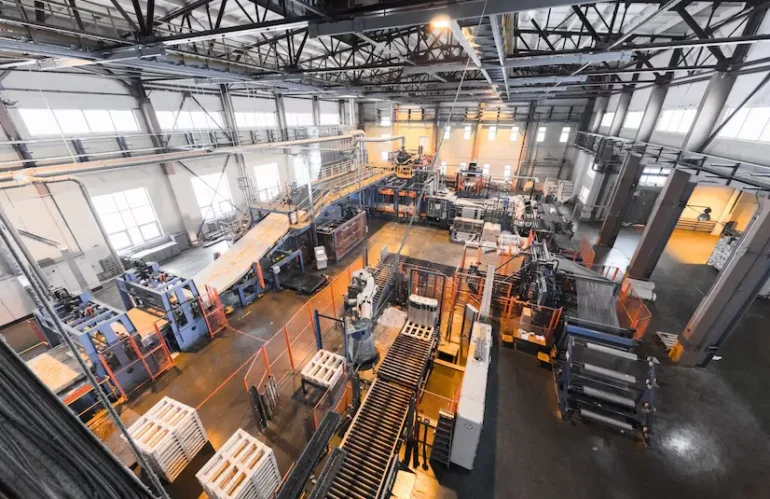
Plant Floor and Warehouse Network Cabling in Georgia
Industrial cabling is mostly a set of environmental decisions made before anyone pulls a reel. Get them right and the network is boring for a decade. Get them wrong and maintenance spends years chasing intermittent faults on a line that cannot stop for troubleshooting. Four decisions carry most of the weight.
Decision one: what the environment does to the cable
Walk the route and note what each run passes through. Heat above an oven or under an uninsulated metal roof, oil mist, washdown chemicals, abrasion where a cable crosses a rack upright, vibration near presses, and electrical noise from variable frequency drives and welding equipment. Ambient temperature is the factor most often skipped: copper length ratings assume something close to room temperature, and both that derating and the heat a powered bundle generates inside its own jacket work against you in an unconditioned Georgia warehouse in August. It belongs in the calculation as a number, not as a shrug.
Decision two: copper, fiber, or both
A copper channel is limited to 100 meters including patch cords, and in a building measured in hundreds of thousands of square feet that limit, rather than the budget, decides how many network rooms get built and where they go. Anything crossing between separate structures should be fiber. Two buildings on separate grounding systems with a copper run between them is a lightning path, and Georgia storm season gives that arrangement plenty of chances to fail. Multimode handles most in-plant backbone; pulling singlemode is worth the small premium on a campus likely to grow.
Decision three: how sealed it actually has to be
Enclosure and connector ratings should match the real cleaning method, not the general impression of the room. Sealed hardware rated for high-pressure, high-temperature washdown and field connections built for it belong anywhere a crew turns a hot water wand on the equipment. Georgia’s poultry and food processing plants are washdown environments end to end, where stainless hardware is a sanitation requirement rather than a preference. Humid air sealed inside an enclosure that later cools will condense on the components, so breathers or enclosure heaters earn their keep in this climate in a way they do not in a dry one.
Decision four: topology and separation
Controls traffic and business traffic should not share a broadcast domain. Managed industrial switches, a ring or a redundant star on the plant floor so one damaged fiber does not idle a cell, and a documented boundary between the operations network and the business network are the difference between an outage and an inconvenience. Every port, drop and patch gets labeled to a scheme a maintenance technician can follow at two in the morning without calling anyone.
Where this comes up in Georgia
Manufacturing along I-75 through Macon and Columbus, distribution buildings still going up along I-16 and I-95 behind the Port of Savannah, cold storage and food processing statewide, and metro Atlanta light industrial space converted from an earlier use and now filled with automation the shell was never wired for. In high-bay distribution space, tall racking and metal inventory turn wireless coverage into a survey problem rather than a catalog exercise, and the answer usually involves more access points and more cable than the floor plan first suggests.
Bring us in before the equipment lands
KSEDCO designs and installs industrial network cabling, wireless, surveillance and access control for manufacturing and distribution facilities across Georgia. If the plant is still on paper, our new construction page covers the milestones that matter. Call (888) 360-0035.