
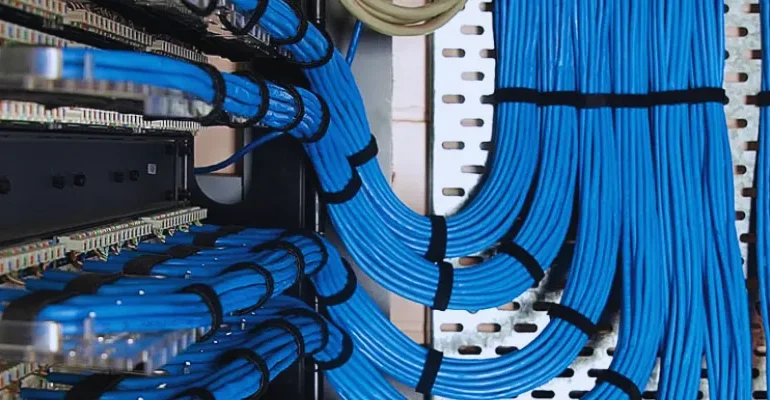
Office Cabling for Georgia Businesses
Two cabling quotes for the same office suite can differ by a factor of two, and the reason is almost always that the estimators answered different questions about the space. These are the questions worth settling before anyone prices the work.
Questions we ask before quoting an office
How long do you hold the space?
A five-year lease with no growth plan is a different specification from a floor you intend to occupy for fifteen years. Cat6 carries what most offices run today. Cat6A costs more per drop and takes more pathway, and it earns that cost when the space will see multi-gigabit access switching, dense high-power wireless, or a tenant improvement nobody wants to repeat in four years.
Where does the building hand off service?
In a multi-tenant high-rise the carrier stops at the building’s point of entry, and getting from there to the suite means the landlord’s riser, the landlord’s rules and often a vendor the landlord names. That extension is frequently the longest lead item on the whole project. It gets identified in week one, not the week before move-in.
Fixed offices or open plan?
Home-run cabling to a patch panel is the default and the right answer for hard-walled offices and conference rooms. Benching and furniture-fed workstations are usually better served by running to a consolidation point in the ceiling with short runs out to the furniture, so the next reconfiguration touches one zone instead of the whole floor.
What else is going to ride this cable?
Access points, cameras, door controllers, displays, sensors and sometimes lighting all draw power over the same infrastructure. Higher-wattage powered devices raise the temperature inside a bundle, which changes how it is bundled and how far it can run. Counting only the desks undersizes the job before it starts.
Who owns the closet?
Someone has to commit to a lockable room with dedicated circuits, a ground, cooling that still works after hours when base building air steps back, and clearance to swing the rack open. A network closet sharing space with janitorial supplies is a service call already written.
What you should receive at the end
- Certification results for every permanent link, delivered as a file you keep
- One labeling scheme applied at the outlet, the patch panel and the drawing, all three matching
- As-built floor plans showing drop locations and numbers
- Rack elevations and a port-to-outlet record for whoever supports the network next
Georgia notes
Fit-outs in the Cumberland and Galleria submarket, Perimeter and Midtown almost always involve base building coordination, after-hours freight elevator scheduling and a certificate of insurance on file before the first cart rolls, and those approvals take longer than the cable pull. Suburban single-story offices in Athens, Augusta, Macon and Columbus trade those constraints for longer runs, more exterior work and often a second building on the same site. Anywhere in the state, copper that leaves one building to reach another should be fiber instead, and a UPS in the closet is inexpensive insurance against the power blips that arrive with a Georgia summer afternoon.
Get a walkthrough and a real number
KSEDCO’s Georgia office is at 2700 Cumberland Pkwy SE, Suite 410, Atlanta, and we cover the state from there. Call (888) 360-0035 to schedule a site walk. If the space has not been built yet, start with our new construction page instead.