
Wi-Fi Rarely Fails for Lack of Signal
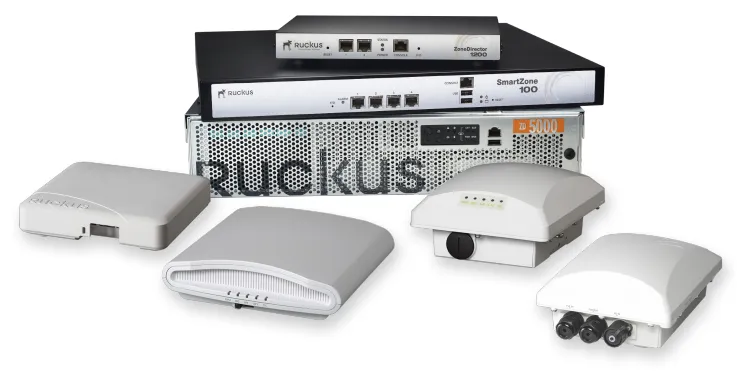
Nearly every wireless problem KSEDCO gets called into on a Georgia site shows full bars on somebody’s phone. The actual complaint is that video calls drop, handheld scanners fall off in one aisle, or a whole floor slows to nothing at 9:30 on a Tuesday morning. Those are density, interference and roaming problems, not coverage problems, and they are exactly what RUCKUS Networks builds its hardware around. RUCKUS has been part of Belden since July 2026, having previously sat under CommScope; the product line and its BeamFlex antenna work carried across unchanged.
Too many clients, not too little signal
Student housing around the University of Georgia in Athens is the clearest version of this. Every resident brings a laptop, a phone, a streaming stick, a console and a speaker, and they all want the radio at the same hours. The same curve shows up in an Atlanta hotel with meeting space, in a conference room that seats sixty, and on a production stage between setups.
RUCKUS BeamFlex+ adaptive antenna technology is the relevant piece. Rather than radiating the same pattern in every direction, the access point shapes its antenna pattern per client, which raises usable signal against a noisy background instead of simply adding more noise to it. Combined with automatic interference mitigation and Wi-Fi 6 and Wi-Fi 6E support, that is what keeps a packed room usable rather than merely connected.
Rooms that fight the radio
Distribution buildings behind the Savannah port are hostile RF environments by construction: steel racking, metal-clad walls, and forklifts that move the reflectors around during a shift. A survey taken in an empty shell is not the building you have to cover, so we survey racked and loaded. Metro Atlanta production stages have the opposite geometry, enormous open volume with hard surfaces and a client population that changes with every production, which argues for a design that can be re-tuned rather than one that is tuned once.
Outdoor in a Georgia summer
Outdoor access points here have to hold up to sustained heat and humidity, afternoon thunderstorms most of the summer, and on the coastal plain, hurricane-season wind and salt-laden air. Enclosure rating is the obvious decision. The one people skip is the drop: any copper leaving a building needs surge protection at both ends and a proper bond, or the first real storm takes the switch port out along with the access point. Where a cable run cannot be justified at all, mesh covers a yard, a parking deck or a second building on a Macon or Columbus manufacturing site without trenching.
The wired side has to keep up
- RUCKUS ICX switches for Layer 2 and Layer 3 with PoE and PoE+ where access points and cameras share the same closet and the same budget
- Multi-gigabit ports where Wi-Fi 6 and 6E access points will genuinely exceed a one-gigabit uplink, which is most new deployments
- Virtual stacking, so a floor’s switches are managed, backed up and upgraded as a single unit
Management, onboarding and evidence
SmartZone runs as a cloud service or an on-premises controller, which matters for multi-site clients who want one pane of glass across Atlanta, Augusta and a coastal property without three separate logins. RUCKUS Analytics is the assurance layer that answers the argument nobody can otherwise settle, showing whether a complaint traces to the wireless, to DHCP or to the uplink.
Cloudpath Enrollment System handles secure onboarding. That is the practical answer for hotels, student housing and any site where a shared passphrase would be circulating off campus within a week. WPA3 and role-based access control cover the rest.
How we prove it works
Predictive design first, then a validation survey with the space in its working state: occupied, racked, loaded, doors closed. SpeedFlex gives a repeatable throughput measurement from access point to client that can be run again in six months and compared. What gets handed over is the survey heat map, the channel and power plan, and the final mounted locations, so the next change is made against a record instead of a guess.
KSEDCO designs, installs and validates wireless across Georgia from 2700 Cumberland Pkwy SE, Suite 410, Atlanta GA 30339. (888) 360-0035.