
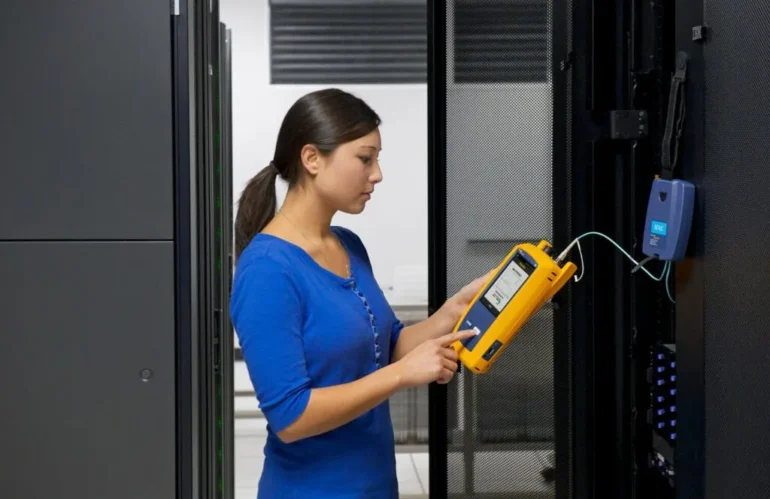
The Test Report Is the Deliverable
“It lights up” is not a test result. A link can pass traffic at a gigabit today and fail at 10 gigabit, or fail once the room warms up in August, or fail intermittently for two years while everyone blames the internet provider. Certification testing exists to replace that uncertainty with a document that has numbers and margins in it.
Three Tools, Three Very Different Claims
- Verification is a toner and a continuity tester. It tells you the pairs are landed in the right order and says nothing at all about performance.
- Qualification tells you a link will support a given speed today. It is useful for troubleshooting an existing run and is not accepted as certification.
- Certification is a field tester in the Fluke DSX or NetAlly class measuring against the published limit line for the category installed. This is what a manufacturer warranty and a general contractor’s closeout package both require.
Anyone who says “we tested it” without naming which of the three they performed has not answered the question.
What a Copper Certification Report Contains
Per link: wiremap, length, insertion loss, NEXT and PSNEXT, ACR-F, return loss and propagation delay skew, each reported as pass or fail with the worst-case margin and the pair it occurred on. The report header matters as much as the results. It should name the tester model and serial, the calibration date, the adapter type, the standard and category tested against, and whether the measurement was a permanent link or a channel. Those two are not interchangeable, and a report that does not say which one it is cannot be audited later.
Fiber Is Tested Differently
Tier 1 is an optical loss test, taken in both directions at both applicable wavelengths and compared against a loss budget calculated from length, splices and connectors. Tier 2 adds an OTDR trace that shows where the loss actually is. Before either one, end faces get inspected and cleaned. Contamination on a connector end face is the leading cause of fiber link failures and is completely invisible without a scope.
Failures That Show Up in Georgia Buildings
- Heat. Insertion loss rises with temperature, and cabling standards derate permanent link length above 20 degrees C. A Cat6A run at 88 meters is comfortable in a conditioned office and marginal in the ceiling of an uncooled distribution building near Savannah or Macon at the end of a July afternoon. Where we can, we test in the conditions the cable actually lives in.
- Water in interbuilding conduit. Underground conduit on a Georgia campus is a wet location whether it was designed as one or not. Degraded jackets and wet splices show up first as a slowly rising loss reading, well before they produce an outage.
- Alien crosstalk. Tightly bundled unshielded Cat6A carrying 10GBASE-T interferes with itself. It is a real failure mode, and only an alien crosstalk test will find it.
- PoE-loaded bundles. High-wattage PoE in a tight bundle raises conductor temperature and, with it, insertion loss. Test after the load is on, not only at rough-in.
What You Should Receive
Native tester result files, not just a PDF summary, because the native files are what a manufacturer warranty claim requires. A per-link summary table. Labels on the plant that match the labels in the report. And a marked floor plan, so the next person who has to find drop B-114 does not lose a morning to it.
KSEDCO tests and certifies new and existing cabling plant throughout Georgia. Call (888) 360-0035 to schedule an audit or a post-installation acceptance test.