
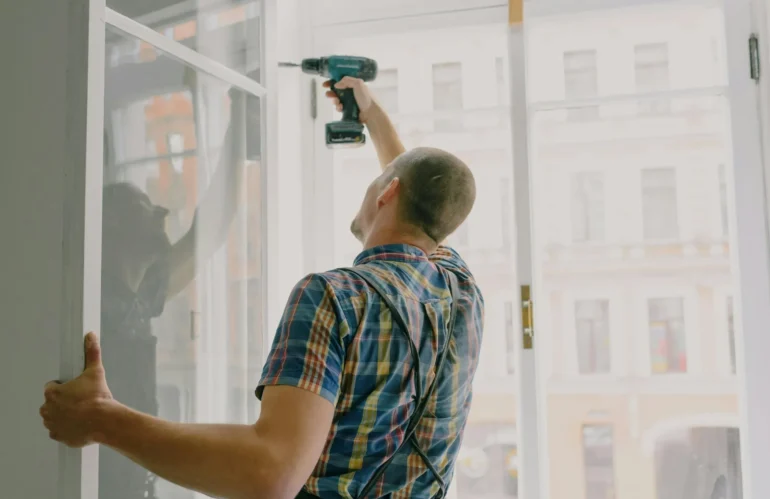
Display Mounting Starts Behind the Drywall
Most failed display mounts we get called to repair failed at the wall, not at the bracket. A screen that comes off the wall in a lobby or a waiting room is a safety problem, not an inconvenience, so KSEDCO treats commercial display mounting as structural work first and AV work second.
What is actually holding the display
Georgia commercial construction hands us three common conditions, and each one is mounted differently.
- Metal stud and drywall — the norm in Atlanta office and medical fit-outs. Sheet metal studs are not lumber. The mount either spans multiple studs into anchors specified for that assembly, or the wall gets plywood backing before the finish goes on. Toggle anchors in drywall alone are not a mount for a commercial panel.
- Concrete and CMU — schools, older municipal buildings, and industrial space along I-75 and I-16. Anchors have to land in the block web or be selected for a hollow cell, and drilling has to avoid grouted cells with reinforcement in them.
- Wood stud — smaller retail and older commercial buildings. Straightforward, provided lag length and actual stud location are verified rather than trusted to a stud finder.
Panel weight and mount rating both get checked against the specific model. A full-motion arm multiplies the load at the wall compared with a fixed mount carrying the same panel, and that is exactly where undersized anchors show up.
Commercial panel or consumer television
For a break room, a consumer set may be fine. For a lobby, a menu board, an operations dashboard, or anything running most of the day, a commercial-grade panel is the right call: a longer rated duty cycle, portrait rating where the layout needs it, RS-232 or IP control, and warranty terms that do not exclude commercial use. Ordering a consumer television for a 14-hour-a-day application is an expensive way to save money on a display.
Cabling and power done once
A recessed combination box behind the display holds the receptacle and the low-voltage terminations inside the mount depth, so the panel sits tight to the wall and nothing shows. Cable inside a wall has to be in-wall rated, and plenum rated where it crosses a return air space. Long HDMI runs over copper are unreliable, so past roughly 25 feet we extend over structured cable or distribute over the network. Anything fed from a rack or IDF gets labeled at both ends, which is the difference between a five-minute service call and an hour of tracing.
Placement details that get missed
- Protrusion into circulation paths — a wall-mounted display in a corridor has ADA limits, and a recessed or low-profile mount is usually the answer
- Sightlines from where people actually sit or queue, not from the middle of an empty room
- Glare from west-facing glass and from fixtures directly above the panel
- Heat — a display set into a sealed millwork opening needs ventilation, especially in a building whose HVAC setback runs warm overnight through a Georgia summer
- Service access — how the panel comes off the wall on the day it has to
At turnover
You get display and mount models, mounting height and center line, wall construction and anchor type, recessed box location, cable type and route, and the control method for each screen. Multi-site rollouts across Georgia get a documented standard so the tenth location matches the first instead of reflecting whoever installed it.
To have commercial displays mounted at a Georgia facility, call KSEDCO at (888) 360-0035 or contact us.