
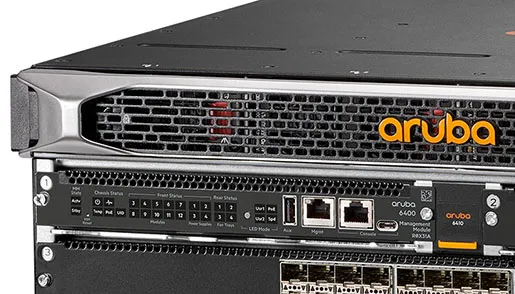
Aruba Wireless and Switching for Georgia Campuses, Fit-Outs and Distribution Sites
Aruba, a Hewlett Packard Enterprise company, builds access points, CX switches, the ClearPass policy platform and the Aruba Central cloud management service. KSEDCO designs and installs Aruba infrastructure across Georgia.
The Management Decision Comes Before the Hardware
Decide how the network will be run for the next five years before anyone picks an access point model. Aruba gives you two different paths: Aruba Central, the cloud platform, or a controller-based deployment you operate yourself. That one choice sets your recurring subscription cost, determines whether a remote site can be fully configured before a technician ever drives to it, and decides who is troubleshooting an uplink at two in the morning.
Central tends to win for an organization with sites scattered from Atlanta to Macon to Savannah and a small internal IT group. A controller-based design still earns its place on a single campus with heavy on-premises traffic and staff who want the configuration under their own roof. What does not work is buying hardware first and sorting out licensing later. Licensing follows the hardware, and unwinding that decision is expensive.
Where Georgia Buildings Make the RF Design Harder
Metro Atlanta tenant fit-outs
Most of our Aruba work along the Cumberland and Perimeter corridors is tenant improvement inside an existing tower, not new construction. That means hard-lid ceilings in some zones and open plenum in others, glass demising walls that provide no RF isolation between suites, landlord restrictions on what you may penetrate, and a schedule anchored to a lease date that will not move. We survey with the ceiling grid in hand, because an AP location that clears the reflected ceiling plan on paper often lands on a soffit in the field.
Athens student housing and instructional space
Student housing is the densest client environment most integrators ever encounter. Every resident brings a phone, a laptop, a console and a streaming stick, and they all want 5 GHz. Density, not coverage, drives the count. We plan for tighter cell sizes, lower transmit power and aggressive band steering, and we treat the wired uplink per floor as the real constraint.
High-bay space along I-16 and I-75
Distribution buildings behind the Port of Savannah and along the I-75 corridor through Macon are a different problem. Ceilings run past thirty feet, racking changes with the inventory, and scanners and lift-mounted terminals roam continuously. Mounting height and antenna pattern matter more than AP count, and a design that assumes the racking stays put will fail within a year.
Switching, PoE Budget and Closet Heat
The access layer is where budgets get discovered late. Once cameras, access control readers, wireless APs and desk phones all draw from the same switch, the PoE budget becomes the limiting number, not the port count. We total the actual draw per closet before selecting a switch, size uplinks for what the wireless layer can genuinely produce, and check the closet itself. A sealed IDF closet in a Georgia building in August, with no dedicated cooling, will shorten the life of everything in the rack. If the closet has no return air path, that gets fixed before the equipment goes in.
How We Sequence a Cutover
Configuration is staged and validated before install day. Switches are built, addressed and labeled off site. On the floor, we bring up the new access layer alongside the old one where the cabling allows, move users a closet at a time, and keep the previous path available until the new one has carried a full business day. Ripping out a working network on a Tuesday morning to save a mobilization is a false economy.
What You Hold at the End
You should finish with port-level as-built documentation, labeled patching that matches it, a validation walk of wireless coverage, administrative credentials in your own hands, and a written record of firmware versions and license terms with their renewal dates. If your team cannot add a switch or change an SSID without calling us, the handover was incomplete.
To discuss an Aruba design for a Georgia site, reach KSEDCO at 2700 Cumberland Pkwy SE, Suite 410, Atlanta GA 30339, or call (888) 360-0035.