
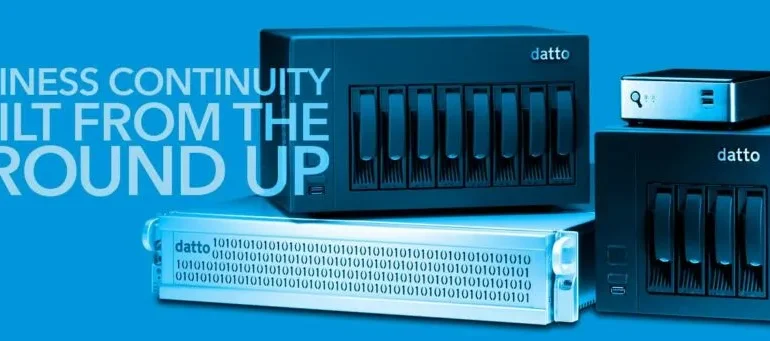
Datto Backup and Continuity: Designing Around Two Numbers
Datto, part of Kaseya, builds backup and disaster recovery appliances, the SIRIS and ALTO families, along with SaaS Protection for Microsoft 365 and Google Workspace, and management tooling including Datto RMM and Autotask PSA. KSEDCO deploys Datto for Georgia organizations. Every meaningful decision in a continuity design comes down to two numbers, and most conversations skip straight past them to product selection.
Recovery Point and Recovery Time
Recovery point objective is how much data you can afford to lose, measured in time. Recovery time objective is how long you can afford to be down. Answer those two honestly, per system, and the design follows.
They are usually different for different systems, and pretending otherwise wastes money. A file server holding drawings may tolerate an hour of loss. A line-of-business database serving a distribution operation running trucks out to I-75 may not tolerate fifteen minutes. Protecting everything to the strictest standard is how backup budgets get rejected. Being explicit about the tiers is how they get approved.
Datto’s local appliance addresses recovery time by virtualizing a failed system on the appliance itself, so a dead server can be running again in minutes rather than after a rebuild-and-restore cycle. The cloud copy addresses the case where the site itself is gone. Both matter; they solve different problems.
What the Appliance Needs on Site
The appliance is a server. It needs rack space, conditioned air and protected power. We see it installed in closets that were never intended to hold equipment, and in Georgia that is a real risk. A closet without a return air path runs hot through the summer, and humidity does the rest. If the space cannot be conditioned, the appliance belongs somewhere else in the building.
Power matters as much. A UPS sized for a clean shutdown, not just a flicker, and generator-backed circuits if the site has them. Storm-season power events in this state are frequent enough that a device losing power mid-backup will eventually happen.
Seeding the First Offsite Copy
The initial replication to the cloud moves the entire protected data set, and this is where branch sites disappoint people. Many Georgia locations outside the metro have asymmetric service with modest upload bandwidth, and the first offsite copy over that link can take weeks while it competes with the business day. We plan for this explicitly: check the actual measured upload speed rather than the advertised figure, schedule the seed against business hours, and use bandwidth throttling so backup does not take the site off the internet.
Coastal Sites Need the Copy Somewhere Else
For an organization operating in Savannah, Brunswick or anywhere else on the coastal plain, the offsite copy has to be outside the geography that a storm can affect. A second copy in the same county is not a disaster recovery plan; it is a second copy. This sounds obvious and it is regularly ignored, particularly when a business has two locations twenty minutes apart and treats one as the backup site for the other.
The same logic applies to the recovery plan itself. If the plan requires someone to reach the building, the plan needs a version that works when the road is closed.
A Backup You Have Not Restored Is a Guess
Datto performs automated verification of backups by booting them and confirming they come up, which is more assurance than most platforms offer. It is still not a substitute for a scheduled restore test performed by your own people. We build a test into the handover: pick a system, restore it, time it, and compare that time against the recovery time objective you set at the start. If the two do not match, the design changes.
Who Holds the Runbook
The last deliverable is a written recovery procedure naming who declares an outage, who executes the restore, what order systems come back in, and what the credentials are. Store it somewhere that does not depend on the systems being recovered.
To review backup and continuity for a Georgia site, call KSEDCO at (888) 360-0035.