
Specifying Panduit on a Georgia Build: Ground It, Route It, Then Pull Cable
Panduit makes physical, electrical and network infrastructure, which is another way of saying it makes the parts of a job that get buried in a wall or bolted to a rack rail and then have to survive fifteen years of moves, adds and changes. KSEDCO specifies Panduit on commercial work across Georgia because the portfolio reaches from grounding hardware and pathway through racks, copper and fiber to the labeling system that ties all of it together. One parts list, one set of standards, electrical room to patch panel.
The order the work happens in matters more than the name on the box. Here is how a Panduit-based build gets sequenced.
Grounding and bonding go in before anything terminates
Georgia gets a great deal of lightning. Metro Atlanta and the coastal plain both run heavy summer thunderstorm activity, and what usually kills switch ports and camera power injectors is not a direct strike but the ground potential difference that arrives with one. Telecom bonding busbars, rack bonding kits and listed bonding conductors go in at rough-in, tied back to the building grounding electrode system. In a distribution building off I-16 behind Savannah, or a plant in Macon, the same hardware carries into control panels and equipment frames.
Pathway, racks and cable management get decided at layout
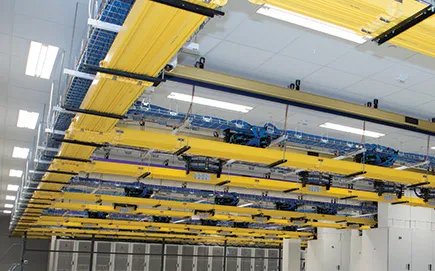
Cable managers, vertical organizers and airflow accessories are a design decision, not something improvised during termination. On a metro Atlanta tenant fit-out, and the Cumberland and Perimeter corridors turn suites over constantly, the closet you build is the closet the next three tenants inherit. High-density vertical management and correctly sized cabinets are what let a re-patch happen in an afternoon instead of a weekend. In the data center corridor north and east of Atlanta the same decision is about air: cabinets, blanking panels and containment accessories that keep hot aisle air where it belongs.
Copper and fiber sized for what the space becomes
- Category 6A, shielded or UTP, where PoE-heavy device counts share a bundle and bundle heat is a real factor: cameras, access points, door hardware, sensors
- Category 6 for general workstation and voice drops where the budget will not carry 6A everywhere
- OM4 or OM5 multimode for risers and equipment room links
- OS2 singlemode for campus and inter-building runs, which is most of what gets pulled on manufacturing sites in Macon and Columbus and on the port-adjacent distribution properties behind Savannah
- Quick-install connectors and patch panels chosen for how the room will be worked on later, not only for how fast it terminates today
Identification is part of the install, not paperwork afterward
Panduit thermal printers, label stock and labeling software produce ANSI/TIA-compliant identification on both ends of every run, on the panel and on the rack. On film and television production stages around metro Atlanta this is not a nicety. Stage infrastructure gets re-patched between productions by people who were nowhere near the original install, and legible permanent labeling is the difference between a plug-and-play stage and a day of continuity testing. Barcode and QR labeling lets the same records live in a facilities system instead of a binder on a shelf in the closet.
What the closeout package contains
Test results per run. A labeled rack elevation. Port-to-outlet records that match the labels physically present on the hardware. The grounding detail as built, not as drawn. Where a client is running SmartZone intelligent monitoring in the cabinet, we hand over the monitored PDU and environmental sensor layout with it.
That environmental baseline earns its keep in this climate. An unconditioned closet in a Savannah distribution building behaves nothing like a conditioned closet in an Atlanta core, and humidity is a design input here rather than a footnote. Capturing the room’s normal condition at handover is what later tells you whether a failure was the hardware or the space you put it in.
KSEDCO covers Georgia from 2700 Cumberland Pkwy SE, Suite 410, Atlanta GA 30339. Call (888) 360-0035 to review drawings or walk a site.