
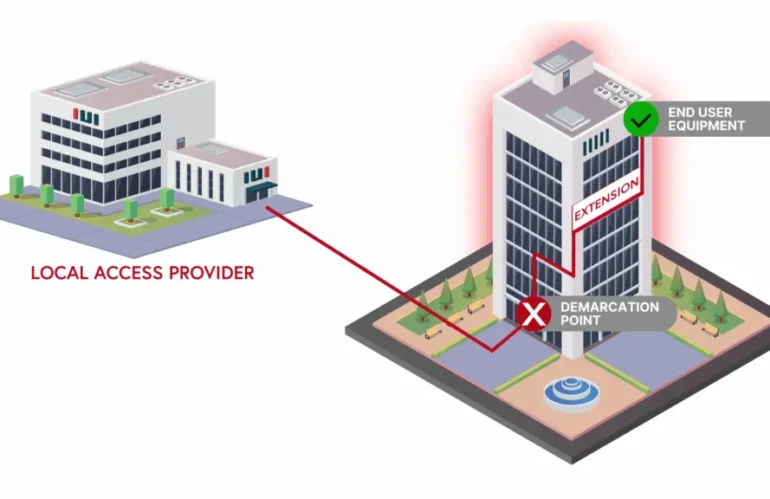
DEMARC Extension: From the Carrier’s Handoff to Your Rack
The carrier’s install date is the fixed point in this whole exercise. On that date a technician arrives, lights the circuit at the demarcation point, and leaves. Everything between that point and your equipment is yours to build, and if it is not ready, the technician still leaves. KSEDCO builds those extensions across Georgia, and the work is organized backward from the turn-up date.
Step one: find out where the demarc actually is
This is not rhetorical. It is routinely the item that blows the schedule.
- Multi-tenant office towers in metro Atlanta. The minimum point of entry is usually a basement or ground-floor telecom room, and the path to a suite eight floors up runs through a riser that building engineering controls. Riser access is scheduled, sometimes days out, sometimes after hours only, and that lead time belongs in the plan from the first day.
- Suburban office parks. The demarc frequently shares a room with electrical gear, which limits where cable may be routed and how close it can run to power.
- Industrial and distribution buildings along I-16, I-75 and I-95. The handoff can land at a pedestal near the property line, several hundred feet from the building. That is no longer an interior job; it is outside plant, with conduit, handholes and a building entrance to design.
- Older buildings. The demarc sits where the original phone service landed decades ago, which is often nowhere near where anyone works today.
Step two: choose the medium, and get the rating right
Inside one building, copper is usually fine and the decision is straightforward. Between two buildings, we plan fiber. That is not a bandwidth argument: Georgia has a high number of thunderstorm days a year, and a copper pair spanning two separately grounded structures is a ready-made path for surge energy. Fiber removes it entirely. Cable rating then has to match the space it passes through, which trips people up more often than it should. Riser-rated cable belongs in vertical shafts. Plenum-rated cable is required where the ceiling is a return air plenum, which describes most Class A office space in the metro. Substituting a lower rating is a code violation, and on a commercial job it gets caught.
Step three: build the run properly
Every penetration through a rated wall or floor gets sleeved and firestopped to the assembly’s listing, and the firestop is restored on the same visit rather than added to a punch list. Cable is supported on its own hangers at proper intervals. It does not get tied to sprinkler pipe, ceiling grid wire or another trade’s conduit, both because those are violations and because the next contractor in that ceiling will cut it. Terminations land on a panel or a wall field, not on a jack dangling behind the rack.
Step four: be ready before the carrier shows up
- The extension terminated at both ends and tested, ideally several days early, not the morning of.
- Both ends labeled with the circuit identifier, so the carrier technician can find the pair or strand without you standing there.
- Rack space, power and the customer premises equipment position ready to receive the handoff.
- Building access arranged for the technician, including after-hours arrangements where the property requires it.
- Your test results printed and on hand. If the circuit does not come up, the conversation with the carrier starts from evidence about which side of the demarc the fault is on, which is usually the difference between a same-day fix and a week of finger-pointing.
What we leave you with
A labeled, tested extension; the cable route documented on a plan; test results for every pair or strand; and firestopping intact at every penetration we opened. To schedule an extension around a carrier install date, call (888) 360-0035 or contact the Georgia office at 2700 Cumberland Pkwy SE, Suite 410, Atlanta GA 30339.