
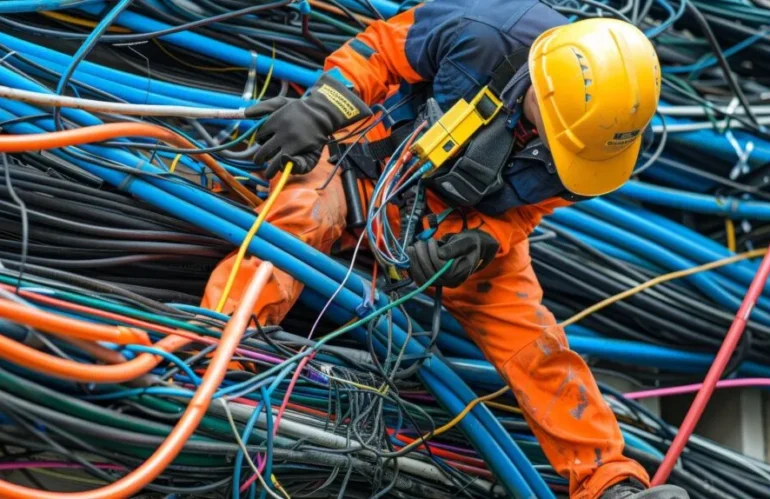
Cable Removal and Abatement Across Georgia
Most cable removal jobs start with a document, not a network problem. A lease restoration clause, a lender’s condition on a building sale, or a fire marshal’s note after an inspection is what puts a date on getting abandoned cable out of the ceiling. KSEDCO does that work across Georgia, from tenant suites in the Cumberland and Perimeter office corridors to distribution buildings along I-16 and I-75 that are changing hands or changing tenants.
What the code actually requires
The National Electrical Code treats abandoned communications and optical fiber cable as fuel load. Articles 800 and 770 call for cable that is not terminated at equipment and not tagged for future use to be removed from the accessible portion of the pathway. Accessible is the operative word. It means the lay-in ceiling grid, the raised floor, the tray and the open riser, not cable cast into a slab or sealed inside a finished wall. That distinction settles most arguments with a landlord or an inspector, and it is worth agreeing on in writing before anyone opens a ceiling.
What we find in Georgia buildings
- Layered tenant history. A suite in an early-1980s Atlanta tower that has turned over four or five times holds four or five generations of cable at once: Category 3 voice, coax, Category 5e, and somebody’s abandoned fiber, bundled together with no labeling that survived any of the moves.
- Plenum ceilings. Most Class A office space in the metro returns air through the ceiling. Everything in that space is plenum-rated, everything that goes back has to be plenum-rated, and work in occupied space has to be coordinated with the air handler rather than around it.
- Warehouse height. Cable in a Savannah or Macon distribution building typically sits 28 to 35 feet up on open tray or J-hooks. That is lift work, not ladder work, and lift access drives the schedule far more than cable volume does.
- Older ceiling assemblies. In buildings that predate the 1980s, the space above the tile may fall under a separate environmental survey. We do not perform environmental abatement. Where it applies, our removal is staged behind the licensed abatement contractor, not run alongside them.
How a removal is sequenced
Live cable gets identified and protected first, before anything is cut. We trace and tag every run that is staying, disconnect and cap what is leaving, then pull from the far end back toward the telecom room so a bundle does not bind up halfway down a congested pathway. Racks and patch panels come out last, after the retained runs have been re-terminated and proven. Debris is separated as it comes down, because copper, jacket and steel go to different streams, and recoverable copper on a large pull is usually worth enough to offset part of the labor.
What you get at the end
- A count of what came out, by cable type, with the recycler’s weight ticket where copper was scrapped.
- Photographs of the cleared pathway, ceiling by ceiling, which is what a landlord’s representative normally wants to see before releasing a deposit.
- Test results on anything retained, so what remains in the building is documented rather than assumed.
- Firestopping restored at every penetration opened during the pull, since removal is one of the most common ways a rated wall quietly stops being rated.
Start with a walk, not a floor plan
We lift ceiling tile in enough places to see what is genuinely up there before quoting. The gap between an estimate drawn from a plan and one drawn from a real look is usually the whole margin on the job. Call (888) 360-0035, or reach the Georgia office at 2700 Cumberland Pkwy SE, Suite 410, Atlanta GA 30339.